


Lloyds Register Of Yachts - 1930
Publisher: Lloyds
Format: Hardback
ISBN: none
Some books are read for plot, others for wisdom, and a select, deeply admirable few exist to tell you exactly who owned what yacht, where it hailed from, and why maritime civilisation remained gloriously committed to organised detail. Lloyd’s Register of Yachts – 1930 belongs to that splendid final category. It is not merely a book but a nautical census of privilege, engineering, ambition and polished woodwork: a snapshot of the yachting world at the very moment the 1920s exhaled and the 1930s arrived in full deck-shoed seriousness.
Published in 1930 by Lloyd’s, this is exactly the sort of volume that makes old reference books so irresistibly interesting. On the face of it, this is a practical register: names, numbers, specifications, ownership, official order brought to the floating fringes of wealth and leisure. But in practice it is far more than that. It is a catalogue of a vanished social world, one in which boats were not only vessels but statements, and in which maritime record-keeping reached a level of elegant administrative confidence that now feels almost heroic.
There is something wonderfully exact about a register. Novels can exaggerate, memoirs can sentimentalise, but a register simply records. It says, calmly and with authority: these were the yachts, these were their particulars, this was the fleet as the world entered 1930. The result is oddly compelling. What begins as reference soon becomes atmosphere. Each entry hints at owners, harbours, summer seasons, maintenance bills, naval habits carried into private life, and the very British instinct that if something floats expensively enough it ought also to be listed properly.
And 1930 is a fascinating year for such a book. The world had not yet quite admitted what the decade might become. There is still something of the late imperial, late grand, late confident world hanging over a volume like this: a sense that order, classification and polished brass may continue indefinitely provided the ledgers remain tidy. That is part of its charm now. The register captures a maritime society at a specific historical moment, still crisply documented, still comfortably official, and still faintly convinced that the sea could be domesticated by tables and categories.
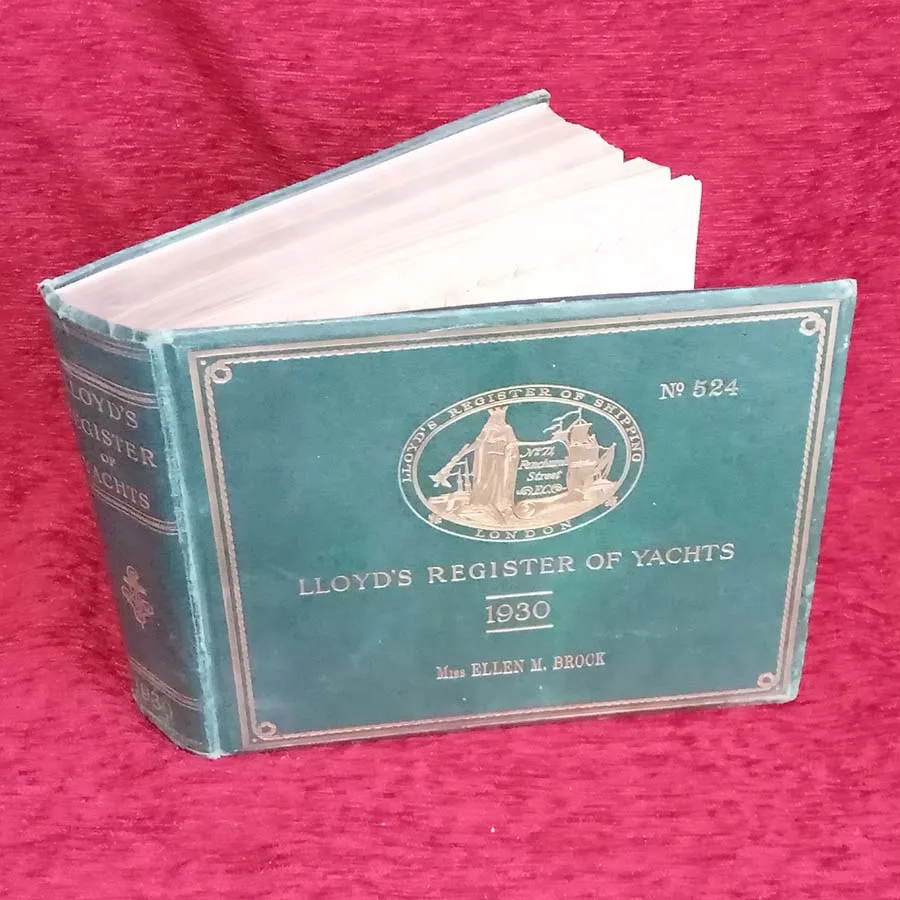
Physically, this copy is a delight. The green boards, gilt-style detailing and Lloyd’s insignia visible in the image give it exactly the right air of institutional gravitas. It looks authoritative before one even opens it, which is precisely how a register ought to look. A yacht register should not resemble a holiday brochure. It should resemble an object capable of settling disputes in a harbour office while also implying that somebody, somewhere, has very strong views about tonnage.
This particular copy also bears a wonderfully specific human touch with the name Miss Ellen M. Brook on the cover, which only deepens the intrigue. Old books with names are often improved by them. They stop being merely surviving objects and become objects with a former orbit. Who was Miss Ellen M. Brook? Owner, enthusiast, secretary, relation to the sea by affection or by paperwork? The register does not say, naturally, because registers are too dignified for gossip. But the name adds exactly the sort of quiet mystery that collectors enjoy.
In Good condition, the volume has survived very well for a book that was never intended as a decorative curio. Registers are working books. They are meant to be opened, checked, consulted and perhaps carried with a degree of purpose. That this one remains so handsome is part of the appeal. Better still, it includes a very abbreviated copy of the 1937 registry, an extra layer of bibliographic interest that turns a good reference volume into a rather more intriguing historical survivor. That addition gives the book a faint sense of continuity across the decade, as though the yachting world, too, deserved its before-and-after.
There is also something deliciously ironic about the whole enterprise. A yacht is, among other things, a symbol of freedom: wind, water, horizon, escape. And yet here they all are, dutifully entered into the ledger, numbered, classified and rendered obedient to administrative order. It is the perfect British compromise. One may have freedom, certainly, but first it will be catalogued.
For the modern reader, this is appealing on several levels at once. It is a maritime reference book, a social artifact, a collector’s curiosity and a design object from the age of serious institutional publishing. It will appeal to yacht enthusiasts, maritime historians, lovers of Lloyd’s material, collectors of interwar reference works, and anyone who enjoys books that accidentally reveal entire worlds through the dry splendour of their data.
In short, Lloyd’s Register of Yachts – 1930 is a marvellously specific and unexpectedly evocative survivor from an age when even leisure afloat demanded proper documentation. This 1930 Lloyd’s copy, in Good condition, and with an abbreviated copy of the 1937 registry included, is a fine Crappy Old Books item: handsome, precise, and full of that rare pleasure only old registers provide — the sense that bureaucracy, if done with enough style, can become history.
Keep browsing: See more Transport books Other books by Lloyds
